
Collections and Publications
Captain Charles Sturt is recognised as one of the most influential explorers of Australia. He followed in the footsteps of Blaxland, Lawson and Wentworth’s first crossing of the Blue Mountains in 1813 and the Hume & Hovell’s journey to Port Phillip in 1824.
Sturt’s family had already played a part in the expansion of the British Empire - his father was a puisine judge in India where Sturt was born on 28th April 1795.
As a young boy Charles was sent back to England for his education and later joined the 39th Regiment (Dorsetshire)-of-Foot serving in France, Ireland and Canada, others part of the developing Empire. By 1825, he had been promoted to the rank of Captain and two years later despatched to Sydney in charge of a guard regiment accompanying convicts to New South Wales.
He was quickly captivated by public speculation about the unknown and unexplored interior of the country. One of the most popular theories was that the series of rivers which had recently been discovered led to a great inland sea. Before long, Sturt was making plans to become the discoverer of this inland sea.

When, in 1828 Sturt was commissioned to explore the Macquarie River, he located the Darling River. In 1829/30 he carried out his most important exploration, the charting of the major river system of Australia, later named the Murray Darling Basin. Sturt published his journal of these expeditions in 1833, gaining significant notoriety in London particularly because of the accompanying report by Capt Collett Barker detailing the fertile coastline of southern Australia. The Journal was the catalyst for the founding of the Province of South Australia in 1836.
Sturt’s direct involvement in the new colony of South Australia began less than two years after its foundation, when he overlanded cattle from New South Wales. He arrived in the new city of Adelaide in August 1838, welcomed as a founder with a public dinner and the offer of the position as Surveyor General. He returned to NSW and brought the family to Adelaide and once built, to ‘The Grange’ on the coast, where another child was born.
These first few years were not easy for Sturt as he discovered that Governor Gawler had had no authority to employ him and that the Commissioners in London had already appointed Lieutenant Frome as Surveyor-General. Although having successfully reorganised the Surveyor General’s Department, Sturt was forced to step aside on the arrival of Frome in October 1833. Over the next few years he served as Assistant Commissioner of Lands and the Registrar-General.
Feeling despondent, Sturt sought to escape the routine of public service life and anxiously longed for a commissioned expedition he could lead. Without any offers he prepared his own grand plans for a two-year exploration and survey of the interior in a bid to discover that elusive inland sea. But with the Province in the throes economic depression, Sturt was forced to settle for a modified plan to explore central Australia.
The expedition left Adelaide on 10th August 1844, returning on 19th January 1846. He had reached within 240Kms from the geographical centre of Australia but had found neither fertile land, useful water or an inland sea. The deprivations were many and scurvy plagued the party. Sturt returning blackened by the disease and remorseful of the loss of James Poole, to the same illness. Though bitterly disappointed, Sturt returned to England where he published his astute observations in an account of this central expedition.
On his return to Adelaide in 1849, he was appointed to the important government post of Colonial Secretary, but with failing eyesight he was forced to retire in 1851 . He returned to England in 1853, where he was widely respected for his work in Australia. Sturt was awarded the Founder’s Gold Medal by the Royal Geographical Society. Queen Victoria acknowledged his accomplishments and awarded him the Order of St Michael and St George [KCMG]. On 16th June 1869 Sturt died at his home in Cheltenham, Gloucestershire before his award could be officially Gazetted.
Captain Charles Sturt

Sturt’s Camp site by the Murrumbidgee River 1829
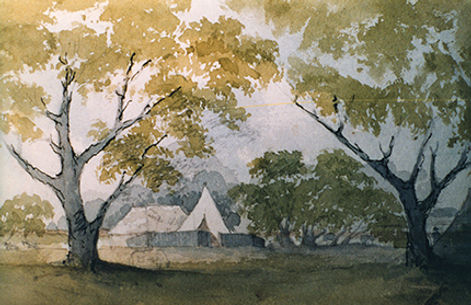
Sturt’s Fort Grey campsite 1845
The Sturt Collection
The Sturt Collection is of national significance. It is the largest collection of Captain Sturt’s artefacts in the southern hemisphere. The Collection was entrusted to the Charles Sturt Memorial Museum Trust Inc in 1966 by members of the Sturt family in England and includes other items that are provenanced to Sturt and donated by members of the South Australian public.
The Sturt Collection has its origins with the family of Napier Sturt, eldest son of Charles Sturt. Napier retired from the army in 1889 to Llanvihangel Court Monmouthshire where he and his wife Beatrix, the biographer of Charles Sturt, lived until 1910.
As a widow Beatrix lived for over 40 years at Winterdyne, Bewdley Worchester with her daughter Katharine who ended her days at Uley Lodge Dursley, Gloucestershire. Katharine inherited much of the furniture belonging to Charles and Charlotte through her cousin Charlotte Eyre Sturt, daughter of Charles. Other items passed into the possession of her brother Geoffrey who lived at Lullingworth, Painswick, in the same country.
The family furniture for Grange was chosen from Lullingworth and Uley Lodge. Items include Sturt’s kneehole desk, wig stand, Persian carpets, commode, piano stool, sofa table, toiletry mirror, ebonised can seats, handing wall cabinet, cheffonier, dining table and chairs, Dessert set, cellaret, wine cooler, long drop clock.
Historic artefacts include Sturt’s silver cup from the Survey Department, the Union Jacks of the River Murray Expedition and Central Expedition, Founders Gold Medal, 11 maps early 19th century, Finch under Dome, portraits of Sturt’s children, the hairlocks of Sturt and his children, 10 pks seeds from Sturt’s garden, Chinese Thank You Box, Minature Chines lacquered cabinet, quondong bracelets, sapphire ring and pendant.


The Sturt Collection
Charles Sturt’s great grandchild Anthony and great-great-grandchildren (through Napier George) Caroline, Pamela and Gerard were instrumental in assembling the Collection. The Rev. Napier Sturt provided a number of historic artefacts belonging to Charles Sturt’s mother and a considerable legacy to the Trust on his death. Cecelia Sturt donated the paintings by Richard Roche Sturt, the brother of Charles.
The bookcase was acquired from the family of Admiral Lord Rodnay (1718 – 92) who lived at Llanvihangel. In 1885 Napier had a legacy from his cousin, Roza Luisa Josepha, widow of General Sir John Grey and daughter of Captain Henry Evelyn Pitfield Sturt, R.N. The legacy included the Rosewood cane-back armchairs and the firescreens with her own needlework, also the cabin table from her father’s ship HMS Phaeton.
The secondary tier of the collection are items that relate to the original home such as the dining room chandelier, the centre ceiling rose in the dining room, an original piece of dampcourse, a portion of rosecoloured curtain from the Dining Room of Sturt’s home, the original door knocker and a quilt used by the Sturt Family.
The third tier of the collection are artefacts that belonged to Sturt’s contemporaries such as the buttersafe of Governor Hindmarsh, a D-ended Library desk belonging to Major O’Halloran and a travel box owned by John Ainsworth Horrocks. A fourth tier are items donated or purchased from the South Australian public to complete the furnishing of the Grange.

EXPLORE NEWSLETTER
Explore the Charles Sturt Museum Newsletter
Browse past editions of the Charles Sturt Museum Newsletter. Our newsletters contain historical articles, museum news, research and updates about the Museum's collections and activities. Click any Issue below to read or download the PDF.

Books for Sale
"Two Expeditions into The Interior of Southern Australia", during years 1828, 1829, 1830 and 1831" by Charles Sturt.
This book was first published in London in 1833, followed by a second edition in 1834 was a best seller that caught the imagination of its readers. It proved the catalyst for the founding of the Province in South Australia in 1836. It was edited and reprinted by ‘Corkwood Press’ in South Australia in 1999.
$30.00 (inc GST)

“Narrative of an Expedition into Central Australia”, “during years 1844, 5 and 6”
by Charles Sturt.
This book describes his epic journey of exploration 1844 – 1846, for which he was awarded the ‘Founder’s Gold Medal of the Royal Geographical Society in 1847. The book was first published in London in 1849. It was edited and reprinted by ‘Corkwood Press’ in South Australia in 2001.
$40.00 (inc GST)

‘The Story of “Grange”, the Home of Captain Charles Sturt’ by Marjory R. Casson.
This booklet published The Charles Sturt Museum Trust Incorporated tells the story of this house built by Sturt in 1840, in the area then known as the ‘Reedbeds’. It tells the story of the area and contains a plan of the house and environs drawn by his second son, Charles Sheppey Sturt, for his sister in law, Beatrix Sturt, who was his father’s biographer. It is a valuable student resource.
$8.00 (inc GST)

‘The Camp by The River” by Herbert Croker.
This booklet published The Charles Sturt Museum Trust Incorporated recalls Captain Sturt’s voyage down the Murray River and the museum exhibit of his “Camp by the River’ near the town of ‘Maude’ in New South Wales where he assembled the whaleboat and made ready for the journey.
$8.00 (inc GST)

Historical Articles
Click Title or Paragraph to Download PDF's
A memorial to the life of Charles Sturt who numbered amongst those intrepid explorers of the 19th century whose discoveries opened up the continent of Australia and thereby shaped its future history.
A FOUNDER OF SOUTH AUSTRALIA?
STURT ADDRESS 2021 - EXPLORING THE FRONTIER: FROM SOUTH AUSTRALIA TO MARS
STURT ADDRESS 2019 THE LEGACY OF CHARLES STURT
STURT ADDRESS 2018 EXPLORER AND PUBLIC SERVANT
A LIFE TIME OF DECISION MAKING
A broader analysis of Charles Sturt's life does reveal a human being who frequently struggled with his sense of self, his public persona and ambitions, the social consequences of his upbringing, his position in society, his inability to achieve financial security, and his commitment to, and love for, his wife, Charlotte, and his children.
STURT ADDRESS 2025 – A MEMORIAL TO CHARLES STURT
CAPTAIN STURT AND CAPTAIN BARKER – BROTHERS IN ARMS
In 1833, Charles Sturt’s influential book, “Two Expeditions into the Interior of Southern Australia”, was released and quickly became a best seller. The work attracted the attention of several prominent figures, including Robert Gouger and Edward Wakefield, along with their supporters. These individuals were greatly inspired by the book’s contents, particularly the inclusion of Captain Barker’s detailed account of the fertile lands he had explored.
Barker’s observations played a decisive role in shaping the group’s ambitions. Their determination led to a significant milestone on 19 February 1836, when His Majesty, King William IV, signed and sealed the Letters Patent. This official act marked the creation of the Province of South Australia.
STURT’S ENCOUNTER AT WYJUDGA SANDHILL
To understand this incident, one first needs to explain how Sturt obtained his reputation as one of the most considerate of Australia’s explorers, in his dealings with the Aborigines. This begins on Sturt’s first expedition, which was to explore the Macquarie River, beyond the barrier of the Macquarie Marshes.
THE GARDNER'S SON HERBERT BERRY
This is the story of a remarkable man who as a 5 year old child arrived in the colony of South Australia in December 1849. His father was John Berry, who in 1850 was employed by Captain Sturt as his gardener at “Grange’, the home built by the explorer in 1840. Here the Berry family were to live until 1853 when the Sturt family returned to England. Henry was to prove himself a man of many talents and unshakeable integrity. He married well and had 9 children. When he died in 1933, at the ripe old age of 88, he had outlived all his sisters and brothers, his wife and all but 3 of his children. He was also by repute the last person alive in South Australia who had personally known Captain Charles Sturt, his wife and their children who had been his playmates.
STURT’S CENTRAL EXPEDITION
In 1843, we find the restless Sturt proposing to the Colonial Office in London that he lead a grand 2-year expedition into the centre of Australia. The response from Sir John Barrow (of NW Passage fame) is as follows: “I know Mr. Sturt to be an intelligent and anxious man for discovery and of that sanguine disposition that never looks or cares for difficulties; and I am persuaded that if the object he has in view could be effected, he is the man to undertake it … but what he proposes it would be little short of madness to attempt.”
Reflecting on the life of the prominent daughter of the 3rd Lord Alington, Hon. Napier George Henry Alington Sturt and Lady Mary Sibell (Ashley-Cooper) who as a child played with Princess Margaret at Buckingham Palace and married Lt. Commander George Marten in the presence of the King and Queen and the Royal Family. She rose to prominence in a public fight, known as “the Crichel Down Affair”, with Churchill’s government over the compulsory acquisition of farmland during the war. She became a Trustee of the British Museum and brought her passion for Russian and Persian culture and archaeology to the position. She chaired the Buildings and Development Committee for the Great Court which was completed for the Millennium. In 1980 she was appointed Deputy Lieutenant of Dorset and was awarded the Order of the British Empire, followed by the appointment of High Sheriff of Dorset in 1989.
Charles Sheppey Sturt was the second son of Capt Charles Sturt and born at Varrowville in New South Wales when his father was absent driving cattle to South Australia in 1838. Returning to England in 1853 to complete his studies, he subsequently joined the Indian Army, Native Infantry in 1858. He was mentioned in despatches in the Abyssinian campaign and rose to the rank of Major General before retiring in 1893. A keen hunter in his youth, he turned to photography in retirement when living at Newport Castle, Pembrokeshire, Wales.
A carpenter and wheelwright by trade but transported to
New South Wales for life for his involvement in the handloom weavers riots of 1826, he became a crucial participant in the success of Capt Sturt’s River Murray Expedition.
The second base camp for Sturt’s party enroute to Central Australia, Lake Pinnaroo proved to be a haven of freshwater in a landscape of desert. Sturt erected a small stockade and stockyard and arranged for a garden to be established. They were to remain there for four months, making three exploratory forays to the north before abandoning the stockade due to diminishing supply of good water.
IMPERIAL REGIMENTS IN SOUTH AUSTRALIA
The founding fathers of South Australia may have rejected a colony based on convict labour, preferring a planned settlement for freemen established on the principles of egalitarianism. Nonetheless, the presence of a military force was welcomed as a means to maintain the peace, good order and advance the prosperity of the Province. From 1841 to 1870 various regiments of British Imperial troops were stationed in Adelaide. The ”Lobsters” nicknamed by the Adelaide boys for their red coats, were initially better known for their drunken riots, forcing the police numbers to be increased to keep them under control. However by their departure on 1st August 1870 the Governor was happy to praise their orderly and soldier-like behaviour and their ability to uphold the character of the British Army.
Born in England on 25 October, 1815, he was the ninth son and the last of the 13 children born to Thomas Lennox Napier Sturt and his wife Jeanette (nee Wilson). He arrived in the Colony of New South Wales in October 1836, aged 21 years, like many young men of his era, seeking fame and fortune. He went on to become a pioneer and pastoralist, attain high public office and in 1854, to play a major role in the events associated with the Ballarat riots and the subsequent rebellion at the ‘Eureka Stockade’, thereby earning his place in the colonial history of Australia.
COLLECTOR AND CULTIVATOR -CAPTAIN CHARLES STURT
An article published in Cultivator- Australian Garden History.
Captain Charles Sturt (1795-1869) is best known for his explorations of the Macquarie Marshes, River Murray and Central Australia but few realise his abiding passion for natural history.

The Grange circa 1922 by Audrey Shapter
State Library of South Australia


Library Collection
The Library Collection consists of 132 books of 18th and 19th century publications belonging to the Sturt Family.
The library reflects an extensive interest in religion, history, science, literature and politics and is consistent with the cultural mores of a man of Sturt’s standing in polite society.
Of particular historical significance is
-
Bible, the King John Version, Moses Pitt, Oxford 1682 given to Charles Sturt by his mother.
-
Engraved Bible by John Sturt 1725-1726
-
Two volumes of Sturt’s Expedition into the interior of southern Australia. Charles Sturt – Set of 1833 and 1834
-
Narrative of expedition to Central Australia, Charles Sturt 1949
-
Il Goffredo overo Gerusalemne Liberata Del Sig, Torquato Tasso 1622 “To Captain Sturt, an old book from an old friend Keith Lockend 30th April 1847”
-
Twenty volumes of Bell’s Shakespeare, John Bell 1788

Contact
Charles Sturt Museum
39 D Jetty St Grange SA 5022
Phone 8356 8185